

If you’re pulled over for a driving infraction or witnessing someone else get arrested in a public place, you need to know the rules.

Recently received a Florida traffic ticket? Before you write it off and keep things “simple” by making the payment and putting this issue behind you, consider the possible consequences. Are you in a position to fight this ticket and potentially win? In these cases, finding a Florida traffic ticket lawyer will help you coordinate a defense strategy that protects your driving record. Read on to learn more about the steps involved in fighting a Florida traffic ticket.
The officer should have provided you with a citation that has the details of the alleged infraction on it. Use this information to do some research and to check your own driving record to determine what’s at stake. This could be all the information you need to hire a Florida traffic ticket lawyer once you know what you’re up against. Read through any of the other details on the citation, such as the time limits or the locations of any courts so that you’ll know what you need to do if you decide to fight it.
One of the most popular traffic ticket defense strategies is to argue against any presented evidence when you have the opportunity to do so. Write down what you recall of the situation and reach out to any witnesses as well since they might become a part of your case. Landmarks such as speed limit postings and other signs could be important. Did the officer get you on radar?
There are a few different ways in which you might be able to argue a defense of your Florida traffic ticket. These will all depend on the circumstances of the incident itself, so it’s important to have someone that knows what they’re doing review everything as soon as possible after you get pulled over to minimize the chances of missing any important facts.
For example, you might be able to claim that:
Since some of these claims and defenses can be complex, it’s best to work with a Florida traffic ticket lawyer to ensure you’ve considered all the primary aspects of the best route for you before moving forward. Whenever you’re challenging an officer’s interpretation or evidence, you want to feel confident that you’ve got the right evidence to support your own claims
Making what seems like a minor mistake in your interpretation of the law could mean that you end up fighting this ticket and losing. Prepare for your case by leveraging the support of a dedicated lawyer. A traffic ticket lawyer in Florida can help you with all the paperwork for your case and give you an honest assessment of what to expect when you go to court. There’s already enough to worry about when you’re fighting a traffic ticket; avoid being overwhelmed in the process by hiring an attorney who can handle the legal management of your case.
Hiring a traffic ticket lawyer could save you big consequences in terms of fines, points on your license, or higher insurance premiums. It also shows the court that you’re serious about fighting your Florida traffic ticket.
Unless you hire a traffic lawyer to represent you, you must block out the time for your scheduled hearing. You need to let the clerk know in writing or by calling that you want to schedule a hearing and you’ll need your address, phone number, and citation number in order to do this.
In the hearing, the clerk listens to any witnesses on either side and will make a decision on your case. If you are found guilty, you’ll be informed at that time about additional penalties or court costs.
No matter how your case ends, plan to take a look at your driving record to see whether any changes or updates were made. If you did lose the case, you need to verify that the points added to your case are accurate. Avoid errors and reach out if mistakes were made.
Need more insight on a specific case? Hire a FL traffic ticket attorney now.
As of Jan. 1 2021, penalties will be doubled for illegally passing a school bus. The legislation came after several high-profile accidents with fatalities or seriously injured children caused by vehicles passing school buses while students were getting off the buses.
Under the new law, the penalty for failure to stop for a school bus increases from a minimum $100 to $200, according to the Florida Highway Safety and Motor Vehicles Department. If a second offense is committed in five years, the person’s license will be suspended for up to 1 year.
Additionally, the penalty for passing a school bus on the side that children enter and exit when the school bus displays a stop signal increases from a minimum of $200 to $400. If a second offense is committed in five years, the person’s license can be suspended up to two years.
We urge everyone to be extra cautious while passing school buses. As outlined above, the result could be a hefty fine that’s double the amount for the same offense in 2020. A second offense could turn into a bigger nightmare – a suspended license. It’s really not worth the risk.
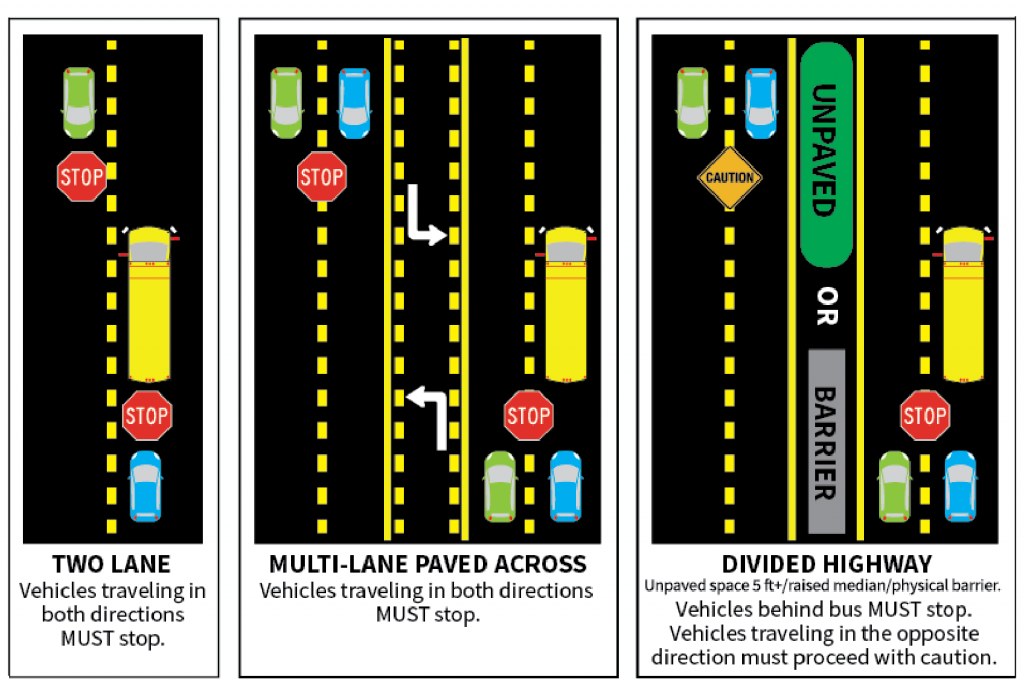
Some motorists might be unsure about when to stop for a school bus. For the most part, drivers must stop on BOTH SIDES OF THE ROAD when a bus is stopped and unloading. The bus will have it’s sign and lights activated. The only exception is if the road has an UNPAVED DIVIDER. The Florida Department of Highway Safety and Motor Vehicles has created this handy graphic below.
While we really hope you slow down and stay alert near buses and never get pulled over for this offense, our attorneys are always on standby to help with any type of traffic citation. Call 1-800-CITATION for a free consultation.

The answer is yes! Since lockdown in March, traffic tickets have been steadily rising and are almost back to pre-covid levels in some parts of the state. If you thought authorities would be giving people are break during these pressing times, think again. In the third week of July thousands of red light camera violations were issued just in Dade county!
As Florida began reopening its economy and lifting stay-at-home orders in June, residents and tourists quickly flocked to the Sunshine state’s beaches and attractions. This boom of activity has increased traffic congestion and unsafe driving incidents even though traffic volume is still lower due to COVID-19.
With roadway volume still lower than before the pandemic began in March, many drivers took advantage and racked up more charges for things like reckless driving including speeding more than 100 mph. To lower the number of related accidents, Florida Highway Patrol (FHP) and the Florida Highway Safety and Motor Vehicles (FLHSMV) are working closely together to enforce state driving and public safety laws.
Compared to this time last year, traffic citations are down across the state, and while overall violations have fallen due to COVID-19 quarantine orders, there is a rise in more serious offenses like DUI and speeding.
Since Florida has begun reopening parts of its economy and lifting stay-at-home orders, it is unsurprising there is a slow upward trend in everyday traffic incidents like rear-end and side-swipe collisions. These incidents may be partly due to tourism return to the state’s favorite attractions and beaches, which puts more people on the road. Coupled with the relief of no longer being pent up due to the pandemic, many of these drivers are zooming faster than allowed on less congested roadways.
Early on during the initial requirement to stay home and avoid possibly coming into contact or spreading COVID-19 to others, FHP and FLHSMV recognized the need to prioritize law-enforcement officer safety and minimize contact with drivers. To accomplish this, highway patrol officers will not focus on minor infractions when policing Florida roads, and instead enforce public safety risks like excessive speeding, DWI, and accidents. FLHSMV has also released a helpful guideline on its website to remind residents and out of towners about the importance of not driving recklessly at high rates of speed and never impaired. This effort is part of the “Arrive Alive” campaign to reduce the number of traffic fatalities that occur on Florida roadways every year.
Despite most Florida traffic courts operating on limited availability due to COVID-19 restrictions, those ticketed for infractions can are still responsible for fines and possible court appearances.
FHP takes driving unsafely seriously and will actively stop those who are endangering the public on the highway. If you get pulled over for this behavior, the Florida State Uniform Traffic Code can hand out several punishments in response, including:
Speeding points are the most commonly given record point in the state of Florida, and one should note that anything 30 mph over the speed limit will demand a court appearance. Most criminal traffic offenses qualify as misdemeanors, though felony charges are possible depending on the circumstances surrounding your case. At the end of the day, your record could take a devastating hit if convicted of traffic violations.
Are you facing a moving violation or major traffic charge? Don’t risk going it alone, or worse, paying out the fine because you think a ticket isn’t a big deal. The moment you hand over your money to pay a citation, you are admitting guilt.
Instead, have your situation evaluated by experienced traffic attorneys at The Ticket Clinic . We are real attorneys who not only give you real advice but will vigorously defend your rights, reputation, and freedom. Our firm is by your side every step of the way so that you are never in the dark about your case.
We have represented over 5,000,000 cases and counting across the nation and have successfully represented clients since 1987. The Ticket Clinic is here to help you and provide the best legal representation services so that you can move on with your life.
Call us now for a free consultation at 1-866-248-2846

If you drive anywhere in Florida, you have likely seen the signs warning that vehicle speed is monitored by aircraft. When many read these signs, it would be reasonable to assume that the plane has high tech radars that can zero in on a vehicle to determine their speed. Although this may be a common thought, in many cases, this is not a reality.
A recent article published in the Florida Highway Patrol newsletter sheds some much-needed light on how aircraft determine a vehicle’s speed, which is a far cry from a sophisticated radar. Instead, the aircraft operator uses a pre-marked grid and a stopwatch. This relatively primitive technique is reliable enough for law enforcement to issue a speeding ticket, but just how accurate is it? In defending a Florida speeding ticket issued by airplane, here are some useful challenges that may significantly impact the result of your case.
Yes, an airplane operator can testify that they started and stopped a stopwatch at a particular time, but exactly how reliable is this testimony in satisfying their burden of proof? How do citizens know that: 1) the stopwatch was operating correctly at the time of its use and 2) if the stopwatch was started and stopped at the exact time the officer states? In speeding ticket cases, a mere second or two can make a massive difference in the strength of the officer’s evidence. If they cannot point to specific and reliable facts supporting their testimony, their entire case may crumble.
Florida roads are busy. During an observation period, numerous cars with similar colors make and models can be observed by aircraft. With this issue in mind, it is vital to question the process in which the officer was able to positively identify the vehicle they allege was speeding. Officers cannot rely on educated guesses or a process of elimination. They must show specific indicators that the car monitored was the vehicle that was issued the ticket, as, without this evidence, their case is dead on arrival.
The highway patrol article cites Captain Matt Walker, who states that the pilots use the stopwatch and quarter-mile zones marked on the interstate to estimate speed while operating the aircraft simultaneously. This process raises serious credibility issues as to how proficient an airplane operator can be at both calculating speeds and safely maneuvering their plane. In situations where the weather is an issue, this can raise further doubts as to the validity of the speed estimation, especially in cases where visibility is a question due to high winds and heavy rain.
Pilots are required to not only record the time it takes for a car to travel in quarter-mile increments, but they must also calculate how these readings equate to miles-per-hour. Just because an officer states that they completed the calculation correctly does not necessarily make their calculations accurate. It is essential to nail down how they calculated their math and what data they used in this calculation. Any error in the calculation, no matter how minor, could be grounds to challenge the validity of the entire case.
Aircraft operators do not initiate stops of motor vehicles themselves; instead, they relay their information to a police cruiser on the ground to begin the stop. An effective defense may involve challenging the information the ground officer was relying on and whether it supported their seizing of the suspect vehicle. If there were misrepresentations made from the air that was then relied on by the officer on the ground, a judge may determine that the officer did not have sufficient grounds to pull the vehicle over, which could result in a dismissal of the case.
Speeding tickets can bring significant financial penalties and can place your right to operate in serious jeopardy. It is crucial to never assume that an airplane reading of speed in Florida is accurate enough to sustain a guilty finding on a speeding ticket. By going through the evidence and understanding how airplanes reach their calculations, you may be able to expose a wide gap between allegation and supportable fact. If this is the case, utilizing this in court can ultimately lead to permanently erasing the Florida speeding ticket from your record.
Are you facing a moving violation or major traffic charge? Don’t risk going it alone, or worse, paying out the fine because you think a ticket isn’t a big deal. The moment you hand over your money to pay a citation, you are admitting guilt.
.
Instead, have your situation evaluated by experienced traffic attorneys at The Ticket Clinic. We are real attorneys who not only give you real advice but will vigorously defend your rights, reputation, and freedom. Our firm is by your side every step of the way so that you are never in the dark about your case.
.
We have represented over 5,000,000 cases and counting across the nation and have successfully represented clients since 1987. The Ticket Clinic is here to help you and provide the best legal representation services so that you can move on with your life.
.
Call us now for a free consultation at 1-866-248-2846
In the state of Florida, drivers are subject to a point system that keeps track of the traffic violations they commit over time. Points are added to drivers’ records with each traffic ticket they receive, and if too many points are accumulated over a period of time, the driver can receive severe consequences like suspension of their license. This point system serves to incentivize drivers to abide by the rules of the road and avoid even minor infractions that can cause points to accumulate quickly.
No. Points are not added onto a driver’s record until the ticket is paid, as this is considered an official admission of guilt.
If you choose to fight a traffic ticket and win the dispute, you will not receive any points, as the ticket will have been dismissed. However, if you do not win the dispute, points will be added once you complete any sanctions you received.
Not all traffic infractions carry the same weight when added to your driving record. Traffic tickets’ point values can range from three to six points depending on the severity of the infraction. Some lesser infractions will cost you only three points, while others that are more dangerous or could cause harm to others may result in six.
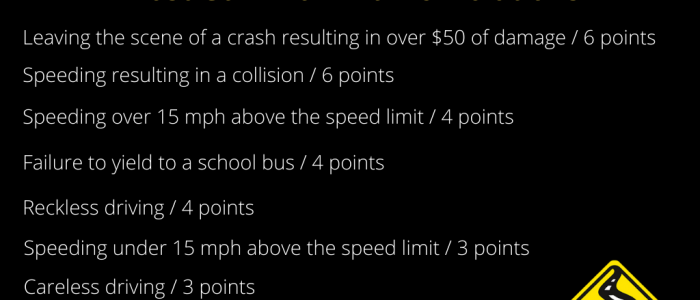
Here are some common traffic violations and the points drivers can receive for committing them:
Speeding under 15 mph above the speed limit / 3 points
Speeding over 15 mph above the speed limit / 4 points
Failure to yield to a pedestrian / 3 points
Littering / 3 points
Careless driving / 3 points
Improper use of child restraints / 3 points
Reckless driving / 4 points
Failure to yield to a school bus / 4 points
Leaving the scene of a crash resulting in over $50 of damage / 6 points
Speeding resulting in a collision / 6 points
Points are accumulated on your driving record for a period of three years. If you receive too many points in a short amount of time, you may be subject to a license suspension of up to one year.
Here are the penalties associated with accumulated points on a driver’s record:
To put the above thresholds into perspective, receiving just three or four minor speeding or careless driving tickets within twelve months can result in a temporary suspension of your license. Involvement in two car accidents in the same period of time can have the same result.
Additionally, even after a suspension period has been completed, drivers cannot take to the roads again until they apply for reinstatement by submitting proof that they have completed traffic school and paying a reinstatement fee.
Because of the negative effects of accumulating points on your record, fighting traffic tickets becomes essential. It is about more than avoiding a fine – it is about ensuring you retain the right to drive a vehicle.
Florida’s point system states that points stay on your driving record for a period of 36 months, or three years. This three-year count begins on the day your ticket is paid or sanctions are completed.
Contrary to popular belief, tickets (and subsequent points) received in one state do transfer to the driver’s state of residence. These points are added to the driver’s record and cannot be reversed by any appellate program or driving school.
The exception to this rule is if the ticket the driver received outside of Florida is not a ticketable or point-accessible violation in Florida. Each state assesses points based on their own laws, not the laws of the state in which the ticket was issued.
Similarly, if the driver moves from one state to another, their points transfer along with their driver’s license. However, the points may be increased or decreased as the state deems necessary according to their own traffic laws.
Points do apply to minors, and they come with more restrictions and harsher consequences.
Minors who receive six points within twelve months receive an automatic restriction of their license for one year or until they turn 18. While similar to a suspension, this restriction still permits driving for essential business only (like work or school). If a minor receives any additional points during this year, the restriction is extended 90 days for every point received.
While tickets cannot be removed from a driver’s record, points can be removed – but with limitations.
Drivers can elect to take a four-hour BDI (Basic Driver Improvement)course to improve their driving record. If selecting this option, the driver must notify the courts within thirty days of receiving the ticket. However, drivers cannot take this course more than five times in total.
The most effective way to keep a ticket and subsequent points from being added to your driving record is to avoid getting these penalties in the first place. After receiving a ticket, the best course of action a driver can take is to hire an experienced traffic ticket attorney. These professionals can assist drivers through the entire process, from scheduling a court date to assembling a strategic defense to get the ticket dismissed.
If you have received a traffic ticket and wish to fight it, call The Ticket Clinic for a free consultation at 1-800-CITATION (1-800-248-2846) or hire us online. Our experienced traffic lawyers have resolved over 3,000,000 traffic offenses nationwide since 1987.
While Florida is in a state of emergency as a result of widespread Coronavirus concerns, many drivers may find themselves questioning the current state of traffic tickets and related court proceedings.
Take a look at these frequently asked questions regarding the impact of Coronavirus on Florida traffic tickets, and our answers:
As of March 16th, Florida’s chief justice has suspended all court proceedings that require face-to-face interaction through May 1st. This decision came as a result of social distancing recommendations from state and federal governments, as well as the Safer at Home order put in place by Governor Ron DeSantis, and is meant to limit the spread of Coronavirus. The temporary suspension includes all non-essential matters, jury proceedings and civil and criminal trials - including those involving traffic proceedings.
Because of these restrictions, if you had a court date after March 16th in the state of Florida, you are not required to appear until told otherwise by the state government. In fact, most local courts are pleading with those whose business at the court is non-essential to stay away. To check the status of your local Clerk of Court services, visit https://www.flclerks.com/page/covid-19
If your original court date fell between March 16th and May 1st, you should expect to receive a notice in the mail with your new court date.
At this time, police officers in Florida are proceeding with business as usual when citing traffic violations.
Traffic violations are considered discretionary, meaning the police officer witnessing the violation can choose whether it is dangerous or reckless enough to warrant a ticket. While Florida is in a state of emergency, officers may choose to be more lenient with certain violations like expired registrations or illegal tints. However, these decisions are in the hands of the individual officers.
Officers will, however, be taking extra precautions to ensure their safety and the safety of the public as they issue tickets and respond to violations.
Though in-person interactions at all Florida courts have been suspended, online services are still available on county courts’ websites. Because of this, Floridians are still expected to pay fines within the standard 30-day window. However, most courts are offering payment plans to accommodate those who are unable to pay traffic fines at this time.
If you received a traffic citation and plan to fight it in court, you must follow the regular guidelines and notify the courts of your plans in writing or online within the 30-day window. It is important to note that failure to respond to a citation, even during the court’s suspension of in-person transactions, is still a punishable offense and could result in heftier fines and the suspension of your driver’s license.
If you have received a traffic ticket during the Coronavirus pandemic and wish to fight it, call The Ticket Clinic for a free consultation at 1-800-CITATION (1-800-248-2846) or hire us online. Our experienced traffic lawyers have resolved over 3,000,000 traffic offenses nationwide since 1987.

The Move Over Law originated in 1994, when a paramedic in South Carolina was struck and injured while responding to an emergency situation roadside. Since then, all fifty states in the U.S. have adopted some version of a Move Over Law to protect emergency responders in the line of duty.
50 of the 50 United States currently have and enforce a Move Over Law. Though each state has some version of this law, the regulations surrounding them differ quite a bit. For instance, the Move Over Law in California simply requires drivers approaching stationary emergency vehicles to “slow down,” while Wyoming’s statute requires drivers “to merge into the lane farthest from the vehicle when traveling in the same direction, if safe to do so, or to slow to a speed that is 20 miles per hour less than the posted speed limit.”
So, with so many variations, how should drivers interpret the Move Over Law in the state of Florida?
The Move Over Law in the state of Florida, also known as Florida Statute 316.126, was passed in 2002 and requires drivers to respect emergency vehicles giving audible or visible signals both en route to emergencies and stationary while assisting emergencies on the side of the road.
When approaching or being approached by an emergency vehicle that is en route to an emergency, drivers must immediately vacate any intersection, travel to the closest edge of the roadway, and stop until the vehicle has passed.
When passing a stopped emergency vehicle on the side of a roadway of two or more lanes, drivers must vacate the lane closest to the stopped vehicle(s) and slow to a speed less than 20 miles per hour less than the speed limit (or, if the speed limit is 20 miles per hour or below, slow to a speed of 5 miles per hour). When passing a stopped emergency vehicle on a single-lane road, or if unable to change lanes on a roadway of two or more lanes, the driver must slow speeds by the same quantities.
Pedestrians must also recognize the Move Over Law by yielding to emergency vehicles until they have passed and otherwise adhering to the right of way (unless directed to do otherwise by a law enforcement officer).
This statute also requires the DMV to provide educational campaigns to ensure the public is informed about the Move Over Act.
Because the Florida Move Over Law is rather all-encompassing, there are many ways to violate this statue and receive a ticket. Common violations include speeding past or failing to slow down when approaching an emergency vehicle, failing to move out of the way of an approaching emergency vehicle, or traveling too closely to a stopped emergency vehicle on the side of the road.
Drivers can receive tickets for any of these violations, regardless of the damage caused by their actions or lack thereof. However, if any of these actions cause harm to fellow drivers or emergency vehicles or personell, the violation will be much worse.
The Move Over Law in Florida applies to all emergency vehicles displaying either visual or auditory signals (like flashing lights or sirens) or in the act of providing emergency assistance. This includes tow trucks, first responder vehicles and police.
Penalties for violating the Florida Move Over Law differ based on severity. This type of violation is considered a “noncriminal traffic infraction.”
In general, drivers who violate this statute can expect to pay a fine of at least $120 and incur three points on their driving record. These penalties may increase if the driver has already received multiple points on their record or has violated the same statue in the past. Additionally, drivers who fail to obey the Move Over Law and cause harm or damage as a result will receive heftier punishments.
If you have received a ticket for violating the Florida Move Over Law, you do have options.
Your first course of action should be to hire an attorney with experience in traffic tickets. This will help you build your case and have the best possible chance of fighting the ticket and winning in court. Once you have explained your case to an attorney, they can assist you in building a proper defense.
Some defenses can include an unsafe situation preventing the driver from moving lanes or slowing speeds, lack of or improper notice from the emergency vehicles, or attempting to prevent further damage that would be caused by adhering to the Move Over Law.
If you are looking to fight a Move Over Law ticket in Florida, call The Ticket Clinic for a free consultation at 1-800-CITATION (1-800-248-2846) or hire us online. Our experienced traffic lawyers have resolved over 3,000,000 traffic offenses nationwide since 1987.

Receiving a traffic ticket can cost you big bucks. The fines do not vary much, but the surcharges do vary by state and county. Reckless driving in Florida, for example, may incur different charges in Miami than what you would pay in Jacksonville.
Before you pay the fine, always explore your options, because when you pay the ticket charge you are admitting your guilt and have points added to your driving record.
The best way is to stay out of trouble. This means obeying the traffic rules and keeping your vehicle in good order. And if you have been ticketed for traffic violations? Our experienced traffic attorneys are well-versed with courtroom tactics and will help you get your ticket dismissed or charges reduced. Call us today at 1800-248-2846
Whenever you commit a traffic infraction, you are ticketed; based on the type of violation, you are required to pay fines, and you get points on your driving license.
Accumulating over 12 points on your driving licence in a year will result in a suspended license in Florida for 30 days; 18 points in as many months will earn you a 3-month suspension, and 24 points in years can result in your license being suspended for a whole year. Apart from this, your licence can be suspended for a variety of reasons.
You need to contact the Florida DMV Driver License Office or apply online, and pay the reinstatement fee; depending on the offense, you may be required to pay additional fees or produce documents as asked for by the court.
This suspension is accompanied by heavy fines and possible jail time depending on the severity of the violation and its after effects.
You can get a suspended license in Florida for other reasons, like being delinquent with child support payments, driving without a license or insurance, driving in spite of suspended license and so on.
If you have received a notice of suspension or a traffic ticket that could result in suspension, you need not meekly pay up. Call us at 1-800-2482846.
Disclaimer: The information contained on this website and any linked resource is intended to provide general information about legal matters to the public and does not constitute legal advice and should not be treated as such. The content is not guaranteed to be correct, complete, or up-to-date. NO ATTORNEY-CLIENT RELATIONSHIP. The use of the website does not create an attorney-client relationship. The transmission of information via the website does not create an attorney-client relationship between you and The Ticket Clinic, A Law Firm. Nothing presented on the website constitutes legal advice and shall not be relied upon in any way. Until a signed representation and fee agreement and acceptance of the terms and conditions here and required payment is received and written confirmation from us, there shall be no attorney-client relationship created. No legal advice is being provided. The website is maintained for informational purposes only. Nothing appearing on this site shall be considered legal advice and is presented only as a general statement of the law. Users of the website should not act, or decline to act, based on information or content from this website. The Ticket Clinic, A Law Firm is not liable for the use, or interpretation, of information contained on the website or otherwise presented on accessed through the website, and expressly disclaims all liability for any actions you take or do not take, based on the website's content. *For certain non-moving violations, ask for details. "This disclaimer governs your use of our website; by using our website, you accept this disclaimer in full. If you disagree with any part of this disclaimer, do not use our website. We reserve the right to modify these terms at any time. You should therefore check periodically for changes. By using this site after we post any changes, you agree to accept those changes, whether or not you have reviewed them."